

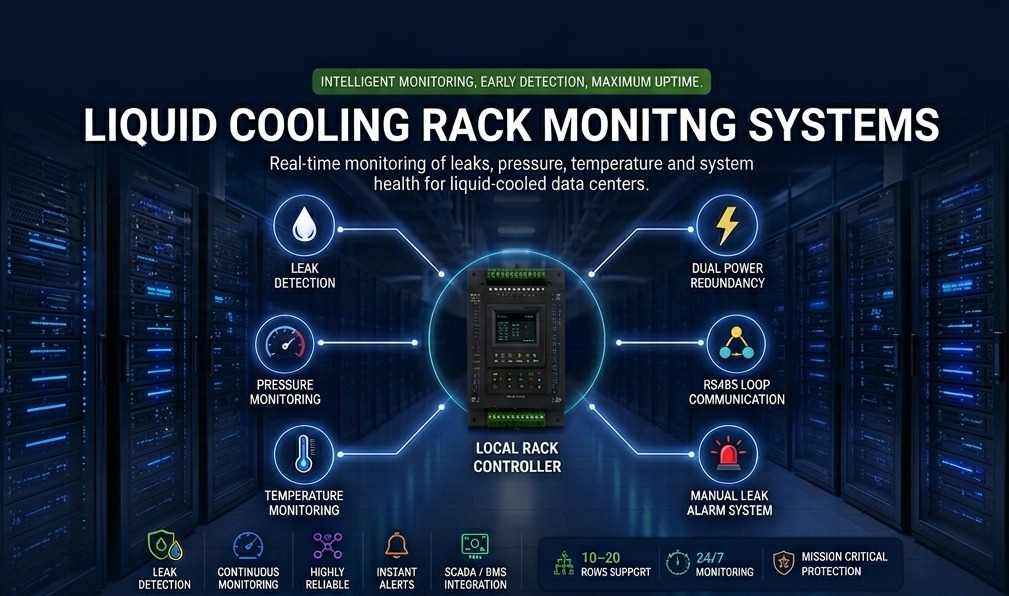
Liquid Cooling Rack Monitoring System (LCRMS)
As data centers continue moving toward high-density computing, AI infrastructure, and liquid cooling technologies, maintaining visibility into rack cooling systems becomes critical. Our Liquid Cooling Rack Monitoring System (LCRMS) is a dedicated intelligent monitoring platform designed to provide complete real-time monitoring, protection, and centralized management of liquid-cooled racks.
The solution continuously monitors coolant leakage, pressure, temperature, communication health, and operational status at the individual rack level, helping data center operators improve uptime, prevent failures, and protect critical infrastructure.
Liquid Cooling Rack Monitoring System (LCRMS)
Why Liquid Cooling Rack Monitoring Matters
Liquid cooling environments introduce operational complexity where even a small coolant leak or abnormal pressure condition can impact system performance and equipment reliability.
LCRMS Delivers:
- ✔ Early leak detection
- ✔ Real-time rack visibility
- ✔ Instant alarm notification
- ✔ Centralized monitoring
- ✔ High availability architecture
- ✔ Seamless SCADA/BMS integration
Product Overview
The Liquid Cooling Rack Monitoring System is designed for rack-level intelligence and row-level protection.
Each Liquid-Cooled Rack Includes:
- 5 or more Leak Detection Sensors (PG-25 / LC-25)
- Supply Pressure Transmitter
- Return Pressure Transmitter
- Supply Temperature Transmitter
- Return Temperature Transmitter
- Dedicated Local Rack Controller
The Local Rack Controller continuously acquires sensor information and communicates data to a centralized Main Control Panel through resilient communication architecture.
Key Features
Intelligent Leak Detection
Detect and respond to coolant leakage instantly using strategically installed sensors.
- Support for PG-25 and LC-25 leak sensors
- Multiple leak sensors per rack
- Fast response monitoring
- Rack-level leak identification
- Fault indication and diagnostics
Pressure Monitoring
- Supply line pressure monitoring
- Return line pressure monitoring
- High-pressure alarms
- Low-pressure alarms
- Transmitter health monitoring
Temperature Monitoring
- Supply temperature monitoring
- Return temperature monitoring
- Temperature trend analysis
- High temperature alerts
Dedicated Local Rack Controller
Responsible for:
- Real-time data acquisition
- Alarm processing
- Communication management
- Rack health monitoring
- Event logging
- Diagnostics
High Availability Architecture
Dual Power Redundancy
- Dual 24VDC Power Inputs
- Two independent power sources
- Automatic power failover
- Power health monitoring
Ensures uninterrupted operation during power source failure.
Peer-to-Peer Communication Network
RS485 Peer-to-Peer Fail Safe Loop
- Communication redundancy
- Loop-back architecture
- Communication failure detection
- No single point of failure
- High reliability network design
Manual Leak Emergency Alert System
Manual Leak Alarm Push Buttons are installed at both the start and end of each row.
Purpose
If operators identify:
- Coolant leakage
- Hose damage
- Pipe leakage
- Moisture accumulation
- Abnormal coolant conditions
The operator can immediately activate a manual leak alarm.
Alarm Process
Manual Push Button Activation
↓
Local Controller receives signal
↓
Main Control Panel receives event
↓
System activates:
- Row-specific Strobe Light
- Hooter / Sounder Alarm
- Event Logging
Alarm transmitted to:
- SCADA
- BMS
- DCIM Platform
Centralized Monitoring & Integration
- Building Management Systems (BMS)
- SCADA Platforms
- DCIM Systems
- MODBUS RTU
- MODBUS TCP/IP
- BACnet (Optional)
Data Points Available
- Leak Sensor Status
- Supply Pressure
- Return Pressure
- Supply Temperature
- Return Temperature
- Manual Alarm Status
- Communication Health
- Controller Status
- Power Source Status
- Alarm Events
- Historical Trends
Typical Deployment Architecture
- 10–20 rows per data hall
- Multiple racks per row
- Rack-level monitoring
- Row-level alarm management
- Centralized control architecture
- Enterprise-level scalability
Industries & Applications
- Hyperscale Data Centers
- AI Infrastructure
- High Performance Computing (HPC)
- Colocation Facilities
- Enterprise Data Centers
- Edge Computing Sites
- GPU Clusters
Why Choose Our Solution
Our Liquid Cooling Rack Monitoring System supports next-generation high-density data centers where reliability, cooling efficiency, and uptime are essential.
Reliable. Scalable. Intelligent. Built for mission-critical infrastructure.
Protect Your Liquid Cooling Infrastructure with Real-Time Intelligence
Get complete visibility and proactive monitoring for your liquid-cooled environment.
Contact Us Today for Demo, Consultation, or Custom Deployment Support.